The Matchmaking Profile Before the Profile
Trace how matchmaking profiles relate to earlier forms of introduction, and see what public notices, personal letters and oral accounts each left unsaid.
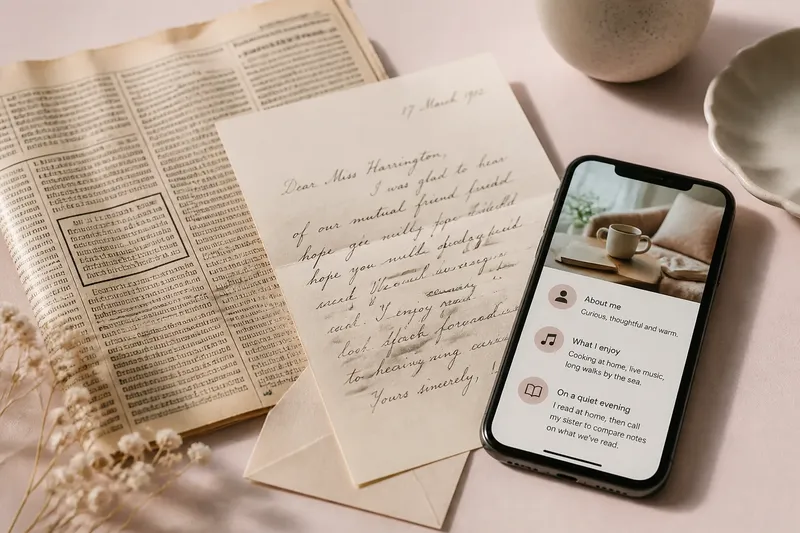
Matchmaking profiles have predecessors in personal notices, letters and spoken introductions, though the surviving evidence does not support a single, tidy history. These forms served different communities and purposes. Comparing them is useful not because one led neatly to another, but because each made a person visible in a different way.
A public notice addressed unknown readers; a letter could carry a more private account; an intermediary’s words depended on personal knowledge and judgement. Contemporary profiles combine elements of direct address and self-description, while adding fixed prompts and visual presentation. The resemblance is real, but it should not be mistaken for an unbroken historical line.
Personal notices made a short case to unknown readers
Personal notices appeared in some newspapers and other publications as a compact way to express an interest in meeting or marriage. Their wording and conventions varied by place and period, so no single template describes them all. The limited space encouraged writers to select a few details rather than offer a rounded account.
Occupation, residence, family circumstances or hopes for marriage might feature, depending on the notice and its setting. Such details could make a person legible to a stranger, but they left much open to interpretation. A stated preference for a settled home, for instance, could mean different things to different readers.
The notice also raises a question of authorship. A person might write in their own voice, or someone else might help compose the words. That distinction matters: a polished description does not always reveal who chose its emphasis.
Read a notice as a selected presentation, not as a complete record of its author.
Letters allowed a more private kind of self-presentation
Written correspondence could carry more context than a brief public notice, while still leaving the writer in control of what to disclose. A letter might address a particular person or follow an introduction, rather than speak to an unknown readership. Its tone, detail and omissions were part of the impression.
Letters are not a simple bridge to the modern profile. Access to writing, postal arrangements and social expectations varied, and surviving correspondence offers only a partial view of who used it and how. It is safer to treat letters as one possible form of courtship communication than as a universal stage in matchmaking history.
The comparison with profiles is clearest in the act of selection. A letter and a profile can both present a chosen version of a person, but a letter responds to an intended reader, while a profile may be composed for a broader audience and organised by a platform’s prompts.
Intermediaries supplied context but also interpretation
Introductions through relatives, friends or community figures rely on someone carrying information between people. That person may offer context that a short written description cannot: why they think a connection is worth making, or what they understand each person to be seeking. The account remains an interpretation, not neutral evidence.
Intermediaries can speak from direct familiarity, repeat what they have been told or combine the two. Those sources are easy to blur. Asking what the introducer knows first-hand, and what they are inferring, keeps the distinction clear without dismissing their help.
This method differs from a profile’s self-authored presentation, but the two can overlap. A person may hear about someone through a friend and then choose how to introduce themselves directly. The intermediary opens a door; they do not write the whole account.
Modern profiles combine older forms without copying them
A contemporary matchmaking profile brings together direct self-description, compact personal details and, often, a photograph. Prompts can make accounts easier to scan, but they also determine which parts of a person are invited into view. A response about leisure, for example, may reveal a preference without showing how it fits into daily life.
This makes the profile both a personal statement and a form shaped by its setting. The writer chooses words and images, while the interface offers categories and limits. That combination differs from a notice in a publication or a private letter, even where the underlying task—making an initial impression—looks familiar.
Imagine a person who wants to convey affection for quiet evenings and openness to occasional outings. They first draft the phrase “easy-going and adventurous”, then replace it with “I like cooking at home and will happily join a friend for a small concert”. The revised wording gives a reader two specific subjects to ask about; it does not settle how either person would spend time together.
What can earlier forms tell us about profiles?
Were personal notices the direct ancestors of dating profiles?
They are a useful comparison, but a direct line of development should not be assumed without evidence for a particular place and period. Both can present a person briefly to prospective connections, yet their audiences, technologies and social settings differ.
What did an intermediary add to an introduction?
An intermediary could explain why they thought two people might connect and provide context from their own relationship with them. That context could also reflect assumptions or incomplete knowledge, so it should be understood as one person’s account.
How is a profile different from a personal letter?
A letter is generally addressed to someone in particular, while a profile may be presented to a broader group and organised around platform prompts. Both involve choices about what to disclose, but their audience and format shape those choices differently.
Can historical comparisons explain what makes two people compatible?
No. They can clarify how different forms of introduction frame a person, but they cannot establish how two individuals will relate. The comparison is about presentation and context, not a measure of compatibility.
The form changes what a reader can see first
Consider a small, invented comparison. A person has a short personal notice, a letter to a particular prospective match and a profile with set prompts. In the notice, they mention that they enjoy reading; in the letter, they explain that they like discussing a book after finishing it; in the profile, a prompt asks what they do on a quiet evening and they write, “I read at home, then call my sister to compare notes on whatever we have been reading.”
The detail shifts with the form: the notice offers a compact interest, the letter addresses a particular reader, and the profile answers a platform prompt. The resulting descriptions offer different openings for conversation, but none tells a reader how an exchange will unfold. That is a distinction worth keeping in view when comparing old forms of introduction with new ones.
Search for “matchmaking profile history” and you will find comparisons between notices, correspondence and profiles; read each as a comparison of formats unless its historical claims are tied to a specific source, place and period.